
Why the Best Brands Stop Selling and Start Earning Attention with Steve Pratt
Subscribe at any of the services listed above. 👌
And if you like what you hear, please consider leaving us a 5 star review!
Steve Pratt

About Steve Pratt
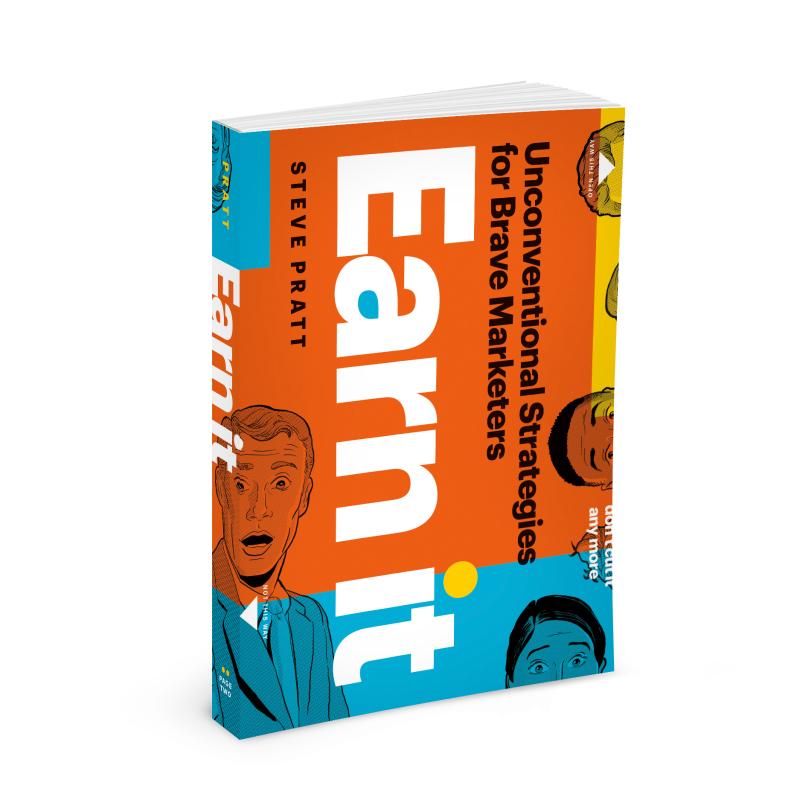
Steve Pratt is the author of Earn It: Unconventional Strategies for Brave Marketers and the founder of The Creativity Business, which offers keynotes, workshops, and consulting to help companies develop differentiated content, marketing, and messaging that earns attention.
Steve is also the co-founder of the world’s first branded podcast agency, Pacific Content, named one of Entrepreneur’s 100 Brilliant Companies. Pacific Content worked with top global brands, including Ford Motor Company, Audible, BMW, the New York Times, Dell Technologies, Facebook, Rocket Mortgage, Slack, Shopify, Zendesk, Morgan Stanley, Charles Schwab, Prudential, Adobe, and Atlassian. Pacific Content was started from scratch in 2014 and was acquired by Rogers Communications in 2019.
Prior to embarking on his entrepreneurship journey, Steve was the director of digital audio at the Canadian Broadcasting Corporation (CBC), where he ran a content innovation lab, launched one of the world’s first legal music podcasts in 2005, and grew a highly engaged online community at CBC Radio 3.
Steve originally learned how to earn attention by producing television, working in genres ranging from music to children’s programming and entertainment journalism to local news.
Steve lives in Vancouver, Canada, with his wife, Debbie, and three kids, Cedar, Dawson, and Charlotte.
Topics discussed in this episode with time stamps
00:00 – 00:36 “Well, I think the learning piece is huge. Like, education is maybe the most overlooked lane for marketing, is that what’s the stuff that you know really, really well, that you’re a deep expert in, that your customers would appreciate learning about, and will probably make them better customers if they’re more educated about it. If you teach a whole bunch of people and make them smarter, and they spend hours and hours and hours with you, when it comes to a buying decision, there’s a much better odds they’re going to choose you if you’ve made their life better and they’ve spent tons of time with you and feel like they know you already.” — Steve Pratt
00:37 – 00:54 Welcome to Peppershock Media’s Marketing Expedition Podcast
00:55 – 02:28 Steve’s Background
02:29 – 07:00 Marketing Essentials Moment: The Origins of Podcasting
07:01 – 10:00 Welcome to the show, Steve!
10:01 – 13:49 Early Podcasting Experiences
13:50 – 17:01 Key Marketing Strategies from Steve’s Book
17:02 – 18:59 Creative Bravery and Commitment in Marketing
19:00 – 24:52 Storytelling and Brand Experience
24:53 – 25:22 The Role of Subtlety in Brand Marketing
25:23 – 26:02 The Overlooked Value of Education in Marketing
26:38 – 28:01 Steve Pratt’s Current Projects and Future Plans
28:02 – 33:59 Midlife Field Guide: Personal Experiments
34:00 – 36:27 Final Thoughts and Marketing Wisdom
36:28 – 37:01 Reach out to Steve
37:02 – 38:31 Earn It: Unconventional Strategies for Brave Marketers
38:32 – 38:53 Thank you so much, Steve! Share this podcast, give us a review, and enjoy your marketing journey!
38:54 – 40:10 Join the Marketing Expedition Community today!
Like what you hear, but need more information?
——————————————————————————————
Read the full transcript
Steve Pratt: The learning piece is huge. Education is one of the most overlooked lanes in marketing. Ask yourself: what do you know deeply that your customers would appreciate learning? If you teach people and make them smarter—and they spend hours with you—your odds go way up that they’ll choose you when it’s time to buy. You’ve improved their life, and they already feel like they know you.
Intro
Welcome to the Marketing Expedition podcast, an auditory journey through the latest in marketing, branding, and advertising. Now, here’s your Marketing Expedition guide, Rhea Allen.
Rhea Allen: On this episode of the Marketing Expedition podcast, I get to speak with Steve Pratt. He’s the author of Earn It! Unconventional Strategies for Brave Marketers and the founder of The Creativity Business, which offers keynotes, workshops, and consulting to help companies develop differentiated content, marketing, and messaging that earns attention.
Steve is also the co-founder of the world’s first branded podcast agency, Pacific Content. Named one of Entrepreneur’s “100 Brilliant Companies,” Pacific Content worked with top global brands including Ford Motor Company, Audible, BMW, The New York Times, Dell Technologies, Facebook, Rocket Mortgage, Slack, Shopify, Zendesk, Morgan Stanley, Charles Schwab, Prudential, Adobe, and more. Pacific Content was started from scratch in 2014 and acquired by Rogers Communications in 2019.
Before his entrepreneurial journey, Steve was Director of Digital Audio at the Canadian Broadcasting Corporation (CBC), where he ran a content innovation lab, launched one of the world’s first legal music podcasts in 2005, and grew a highly engaged online community at CBC Radio 3. Steve originally learned how to earn attention by producing television across genres ranging from music and children’s programming to entertainment journalism and local news.
Steve lives in Vancouver, Canada with his wife, Debbie, and their three kids—Cedar, Dawson, and Charlotte. We’re going to go on a great journey today, and you’re going to learn a lot from Steve.
But first, it’s time for your Marketing Essentials Moment—the basics you need to keep building your brand and your bottom line.
Rhea Allen: We’re going to talk a lot about podcasting with Steve and what it means to earn attention. But first, I want to revisit the origins of podcasting—how it began.
Many people credit Adam Curry, a former MTV VJ, and Dave Winer, a software developer, as early inventors of podcasting. They wanted a way to download online radio broadcasts to an iPod. iPods were released in 2001—can you believe it?
So why is it called a podcast? The name comes from “iPod” and “broadcast.” And to make it work, Curry and Winer used RSS feeds—Really Simple Syndication—as a way to distribute content. An “iPodder” could extract audio files and transfer them to an iPod, so people could listen on demand, on the go.
Podcasts grew quickly. Apple helped popularize them in 2004, and the medium exploded again around 2014. That’s when more syndication took off, true crime surged, and brands started using podcasts to tell stories and build trust.
Today, podcasting keeps evolving: dynamic ad insertion, multiple monetization models, and the rise of video. YouTube, streaming, and audio-plus-video formats have made podcasting more mainstream than ever.
If you’re a brand thinking about how to elevate your story, keep listening. Steve explains how one brand he worked with became a trusted source of information—not by talking about products nonstop, but by delivering value that people associated with the brand.
Let’s get into the interview.
Rhea Allen: Welcome to the Marketing Expedition podcast. I’m your host, Rhea Allen—President and CEO of Peppershock Media and founder of the Marketing Expedition community. Today we have Steve Pratt joining us. Welcome to the show, Steve.
Steve Pratt: Thank you. I’m excited to head out on the expedition with you.
Rhea Allen: That’s right—we’re going on a journey. Start by sharing your path and how you got to where you are now.
Steve Pratt: The short version is I have a media background. I worked in TV for about 10 years across a wide range of genres—from the Canadian equivalent of Nickelodeon (YTV), to the Canadian equivalent of MTV (MuchMusic).
From there, I moved into digital audio at the Canadian equivalent of NPR. I ran a music service called CBC Radio 3, which was online-first with a satellite radio station—but no AM/FM. The goal was to build younger audiences without traditional broadcasting.
We started podcasting there in 2005 and launched one of the world’s first legal music podcasts. It was an innovation lab where we tried a lot of new things—and we had early success.
That led me to leave in 2014 and start a podcasting company called Pacific Content. It was different because we only worked with brands. Our job was to turn brands into media companies—help them build audiences they owned, and create content people looked forward to, instead of interrupting people with ads they didn’t want.
I left Pacific Content in 2022, wrote a book about what we learned, and now I mostly write, consult, and speak about earning attention rather than interrupting it, stealing it, grabbing it, or buying it.
Rhea Allen: So you were podcasting before it was even “a thing.”
Steve Pratt: We were waiting for a satellite radio station to launch and had about a year. Meanwhile, we had a MySpace-style platform where independent musicians who owned their rights could upload songs.
I’d heard Adam Curry doing a podcast called The Daily Source Code. Most of it was technical—how to wire everything up. One big issue back then was music licensing: most podcasters couldn’t use music unless it was “podsafe.”
We realized we could do something different because our musicians owned their rights, and our job as a public broadcaster was to promote them. We launched a couple months before Apple added podcasts to iTunes. When Apple did, they promoted our show heavily because it was one of the only legal music podcasts with great musicians.
It took off worldwide. In 2006 or 2007, we were getting around 140,000–150,000 downloads a week, which was huge back then.
Rhea Allen: And that was around the time iPods were coming out, too.
Steve Pratt: Exactly. Everything was new.
Rhea Allen: I love that. You helped set the stage for what came next. Podcasting has exploded—there are thousands and thousands of shows. We’re doing one right now.
Steve Pratt: It’s funny—back then, Apple had iPod Touch devices before the iPhone, and video podcasts existed even before 2010. You could attach video through an RSS feed and people would download episodes like a show.
We made an early video podcast with a producer named Jordan Kozak. It was like a mini version of The Office for our music service, with musicians guest-starring. It was a fun, creative time. When a medium is new and the rules aren’t set, it’s wide-open space to experiment.
Rhea Allen: It’s like the Wild West.
Steve Pratt: Exactly. A marketing expedition.
Rhea Allen: Without giving away the book—because we want people to buy it—what are a few discoveries or success patterns you saw that worked especially well?
Steve Pratt: The book isn’t a podcasting book, even though there are podcast stories. It’s about marketing strategy, attention strategy, and how to turn that into a content strategy.
The number one principle we pushed—coming from a media background into marketing—was: make stuff people actually want to spend time with.
We used a phrase called “creative bravery.” We’d draw an X/Y graph: one axis was creative bravery, the other was commitment.
You’re not competing with other brands—you’re competing with every media property in the universe: Netflix, HBO, NPR. Attention is finite. People choose what’s worth their time, and the bar is high.
High creative bravery means you’re making a real show. You can ask:
- If I didn’t work here, would I tell other people about this?
- If I could go back in time, would I still choose to spend time on it?
As soon as you slide into “let’s have our CEO talk about our products and services,” you drift toward infomercial territory—and people won’t stick around.
The other axis is commitment: will you use your strengths as a brand to put the show in front of the right people? Most brands have reach and channels that creators would love to have, but they don’t use them to promote content.
We’d audit every way a brand can talk to people. For example, Mozilla could promote content through the Firefox browser and reach exactly the right audience fast.
With Dell, we made a show called Trailblazers hosted by Walter Isaacson. A host like that instantly signals it’s a real show—not an infomercial. Walter got invited onto CBS This Morning to talk about it, and the show went to #1 in business podcasts. That’s high creative bravery and high commitment.
If you have a great idea and low commitment, nobody finds it. If you have high commitment and low creative bravery, people try it once and never come back.
Rhea Allen: I love the phrase “creative bravery.” Creators can be their own worst critics. You have to be brave enough to put something out there. And when brands do it well, people don’t feel sold to—they feel like they’re having an experience.
Tell me about a brand where you helped create something people truly wanted to spend time with.
Steve Pratt: Charles Schwab is a great example. They leaned into creative bravery and commitment.
It’s interesting: people think regulated industries are harder, but in some ways they’re easier—because you can’t talk about your products directly. You’re forced to create value.
We used a phrase: make a show that’s from you, but not about you. What can you make that reflects your values and voice, but is designed for the audience?
Schwab created a show called Choiceology about how to make better decisions. It’s not about finance or investing—though better decisions can lead to better outcomes.
The show is built around behavioral economics: each episode highlights a cognitive blind spot, tells a compelling story, and brings in an expert.
They didn’t use a Schwab employee as host. They hired Katie Milkman, a Wharton professor. Instant credibility. She could bring in major guests like Richard Thaler and Daniel Kahneman.
One episode on sunk cost bias opened with a Mount Everest expedition that went wrong. Everyone agreed they’d turn back if conditions were bad—but after investing months of training and lots of money, they pushed forward anyway, and it ended badly. Then the show unpacks how sunk cost bias shows up in everyday life.
People loved it. They learned a lot. And it happened to come from Charles Schwab.
Then Schwab committed to distribution: features in their magazine, promotion on in-branch digital signage, podcast placement in their app, website promotion, and employee activation through their intranet—called “the Schweb,” which I love.
It’s a very light brand touch. It’s not “Charles Schwab” every five seconds. Think about Game of Thrones: you know it’s HBO, but HBO executives aren’t fighting dragons in the scenes. People remember who made the show without being hit over the head with it.
Rhea Allen: That’s such a good point. People want to be associated with learning, positivity, and value—not constant selling. Subtlety helps.
Steve Pratt: The learning piece is huge. Education is one of the most overlooked lanes in marketing. What do you know deeply that your customers would appreciate learning? If you teach people and make them smarter—and they spend hours with you—your odds go way up that they’ll choose you when it’s time to buy. You’ve improved their life, and they already feel like they know you.
Rhea Allen: Absolutely.
Ad Read:
Want to start a podcast but don’t know where to begin? At Potterific, we don’t just produce podcasts. We help you create auditory experiences that will captivate your audience. Our state-of-the-art podcast recording studio, powered by Peppershock Media, is designed for creators like you. Record with high-quality equipment supported by our expert team and distribute your podcast across major platforms like Apple and Spotify. Whether you’re launching your first episode or you’re a seasoned podcaster, we’ve got you covered. Visit Potterific.com today to learn how we can help you produce, record, and share your story with the world. Your podcast deserves to be Potterific.
Rhea Allen: Steve, what’s next for you? You’ve got the book out and you’re on podcasts talking about it—what’s the next phase?
Steve Pratt: This isn’t strictly marketing, so tell me if it’s off track. I’ve been putting into practice what I’ve done for other people—on projects I’m excited about.
I’m in my early 50s and started a project called The Midlife Field Guide. I’m doing experiments on my life in public with a colleague to figure out midlife. We’re applying creative bravery and commitment, and we’re publishing on Substack. It’s been a treat to get back into making.
I’m also still consulting—helping people find their differentiator, position themselves, and turn that into a content strategy that builds audience and strengthens the business. It’s a fun mix.
Rhea Allen: As someone approaching midlife, I have to ask: what are you doing in the field guide?
Steve Pratt: A few examples:
- I stopped drinking for a year
- I learned to run, starting with one block. I ran a 10K, then a half marathon
- I took a stand-up comedy course with my daughter and we did a live showcase
- I did a phone detox for a month: no social media, no news, and I broke a long Wordle streak
- I stopped tracking everything for a month—took off my Apple Watch and stopped measuring sleep
- I did a bunch of midlife medical tests
Most of these are uncomfortable. But I’ve never regretted any of them. They led to great experiences and deeper connections.
It’s also been fun writing about it. There’s a different muscle when you’re telling your own stories—you can be more self-deprecating and vulnerable.
Rhea Allen: That’s creating with confidence.
Steve Pratt: Exactly. And being honest makes for a better story.
In my first 10K, I’d never been to a water station. I thought I’d grab a cup, drink it, and keep running. Instead, I basically waterboarded myself—choked, had to stop, and pull over.
I was so slow I got passed by parents pushing strollers. At the end, I got passed by two grown men dressed as corn cobs. I got beat by corn.
Those moments are embarrassing, but they’re the best stories—if you pay attention and tell the truth.
Rhea Allen: You were out there doing it. Most people never even try.
Steve Pratt: Exactly.
I also grew a hideous beard for eight or nine months. I’d never grown one before. I looked like a senior-citizen version of Forrest Gump. People told me I looked old. When I shaved it, everyone said I looked 10 years younger. Lesson learned.
Rhea Allen: My husband shaved his goatee once and I didn’t recognize him. I told him not to do that again.
Steve Pratt: It’s like trying on a different personality. People treat you differently. With a big beard, I got invited into more “man stuff.” Other guys with beards would nod like we were in a club. It was hilarious.
Rhea Allen: Before we wrap up, any final wisdom you want to leave with our audience?
Steve Pratt: With AI and all the fear in marketing right now, these ideas matter even more.
Make something with high creative bravery—something only you can do. AI predicts the next likely thing. A common marketing trap is copying what’s working and doing your version of it. That makes you blend in.
Be the only person doing the thing you’re doing. Make something different, special, memorable, and surprising—something people talk about. Even if it reaches fewer people, I’d rather have fewer people who are genuinely excited than average content spread at scale.
Use AI where it helps, but protect your creative space. Do the thinking and writing AI could never come up with. That might be the most creatively brave thing you can do.
Rhea Allen: I love that. Steve, where can people find you and your book?
Steve Pratt: It’s easy: stevepratt.com. The book is Earn It: Unconventional Strategies for Brave Marketers. Thanks for having me on the expedition—it’s been a treat.
Rhea Allen: Thank you for joining me, Steve. I’m looking forward to reading the book.
Steve Pratt: Enjoy it.
Rhea Allen: Do you have an audio version?
Steve Pratt: Yes—and I had so much fun making it. Instead of a straight read, I brought in people I used to work with and we made it feel more like a podcast: music, sound effects, and stories brought to life with audio—like an NPR-style production.
People have told me, “Why aren’t you talking more about what you did in the audiobook?” So I’m glad we got to share it here.
Rhea Allen: I love audiobooks. I drive between Nampa and Boise, so I listen during my commute—either podcasts or audiobooks. I’m excited you made it that way.
Steve Pratt: If you’re not annoyed by the sound of my voice after a while, I hope you enjoy it.
Rhea Allen: Steve, thank you again for joining us.
Steve Pratt: Thanks, Rhea.
Rhea Allen: And for those of you listening, the best thing you can do for Steve and me is share this episode with someone who needs to hear it. And please leave a review—that’s gold. Until next time, enjoy your marketing journey.
Outro:
Thanks for listening to the Marketing Expedition podcast. Want to continue the journey? Don’t miss out on new episodes. Subscribe on iTunes, Spotify, Amazon Music, or wherever you get your podcasts. Wouldn’t it be great if there was one place you can go to get all the latest information and tips about marketing and advertising? The Marketing Expedition community is that place. People like you gather in our online community to build relationships with others and find the latest marketing trends, tactics, tools, and technology. We help you build your brand and your bottom line. Start your adventure today. Visit TheMarketingExpedition.com to find out more.
Links to resources mentioned in this episode
Check out Rhea’s Marketing Expedition Webinars
Thanks for listening to this episode of the Marketing Expeditions Podcast. If you like what you heard today, please subscribe and leave us a review on iTunes, Spotify, or Amazon Music.
The Marketing Expedition Podcast is powered by Peppershock Media, an award-winning full-service advertising, marketing, and video production company.