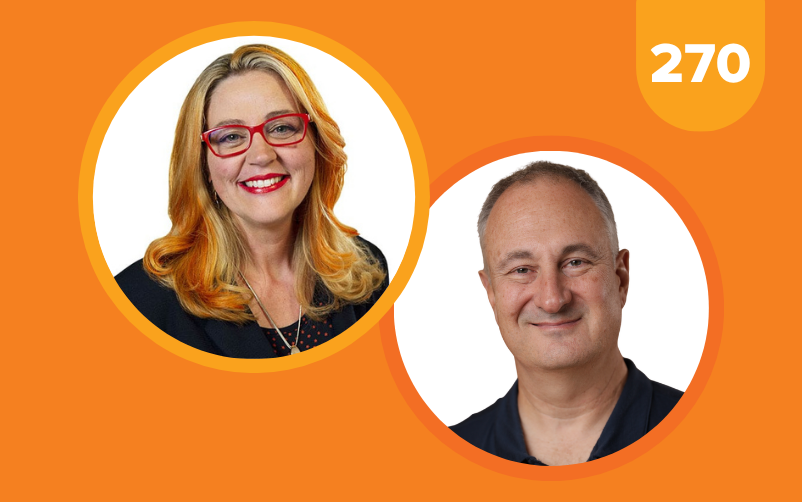
Creating Engaging Corporate Events and Experiences with Mark Mallchok
Subscribe at any of the services listed above. 👌
And if you like what you hear, please consider leaving us a 5 star review!
Mark Mallchok


About Mark Mallchok
Mark Mallchok is the Principal & Chief Event Strategist at Brella Productions, which he co-founded in 1992. A veteran event producer and video director, he has spent more than 30 years creating high-impact corporate meetings and global events for Fortune 100 clients. With a background in theater and film, Mark specializes in audience engagement and designing face-to-face, virtual, and hybrid experiences that support business goals and elevate attendee connection.
Topics discussed in this episode with time stamps
00:00 – 00:25 “This is something that most people putting on events forget, but like the connections and the camaraderie and the moments and those people that you meet and then continue on relationships with, that’s the reason we’re there. And unfortunately, most of the time we try to cram way too much content into our programs and we don’t give enough breathing room and opportunity for people to meet each other.” — Mark Mallchok
00:26 – 00:44 Welcome to Peppershock Media’s Marketing Expedition Podcast
00:45 – 02:28 Mark’s Background
02:29 – 10:41 Marketing Essentials Moment: Post-Event Follow-Up
10:42 – 12:51 Welcome to the show, Mark!
12:52 – 15:27 Transitioning to Corporate Events
15:28 – 17:03 Recent Projects and Client Experiences
17:04 – 22:10 Engaging Audiences with Technology
22:11 – 24:12 The Power of Storytelling in Presentations
24:13 – 26:47 The F Word: Follow-Up
27:23 – 32:14 The Challenge of Information Overload
32:15 – 36:06 Creating Engaging Presentations
36:07 – 42:20 Tips for Memorizing Presentations
42:21 – 48:03 Success During the Pandemic: Virtual Events
48:04 – 53:11 The Impact of Virtual Participation on Events
53:12 – 55:28 Reach out to Mark
55:29 – 56:05 Thank you so much, Mark! Share this podcast, give us a review, and enjoy your marketing journey!
56:06 – 56:52 Join the Marketing Expedition Community today!
Like what you hear, but need more information?
—————————————————————————————
READ THE FULL TRANSCRIPT
Podcast Intro
Rhea Allen: Welcome to the Marketing Expedition podcast, an auditory journey through the latest in marketing, branding, and advertising. Now, here’s your Marketing Expedition guide, Rhea Allen.
Rhea Allen: On this episode of the Marketing Expedition podcast, I get to have a delightful conversation with Mark Mallchok. He co-founded Brella in 1992 with CEO and President Bernadette Burke.
A veteran event producer and video director, Mark has created engaging corporate meeting and event experiences around the world for notable healthcare, financial services, and heavy industry clients. He draws on his theatrical and film background to find compelling stories that anchor client projects and support business and learning goals.
He specializes in audience engagement and participation, combining powerful technical tools with rock-solid narrative and performance techniques to deliver unparalleled face-to-face, virtual, and hybrid experiences. Having started in theater, Mark is passionate about bringing performance into meetings and events and elevating the virtual attendee experience to be on par with in-person programs.
Mark believes strongly in being part of the initial strategic planning process so goals and objectives are identified early and programs can be optimized from start to finish—creating an elevated experience for all attendees.
Having grown up in the melting pot that is Hawaii, Mark loves to travel the world, immerse himself in cultures, and meet people who add breadth and depth to his planning and producing of experiences that engage the mind and impact global organizations.
Mark is a graduate of Northwestern University’s theater program and holds a prestigious CMM designation (Certificate in Meeting Management) and an MMP (Medical Meeting Planner) certificate. We’re in for a treat.
First, it’s time now for your Marketing Essentials Moment—the basics you need to build your brand and your bottom line.
Marketing Essentials Moment: The 48-Hour Follow-Up Machine
Rhea Allen: Today’s topic is post-event follow-up: the 48-hour follow-up machine—how to turn every event into leads without living in your inbox.
Here’s what happens all the time: people go to events, make meaningful connections, then do nothing after they leave the venue. That’s how event ROI dies in the parking lot.
With our monthly Word of Mouth Mixers, I always remind people: the real win happens beyond the walls of the venue. We host these mixers at different business sponsors across the Treasure Valley. Each sponsor invites their people, we invite ours, and it keeps growing.
The key is the F-word my friend Sarah Cortes coined: follow-up, follow-up, follow-up.
Rhea Allen: Step one: don’t treat everyone the same. Sort your connections into three buckets:
- Hot leads: clear opportunity, strong fit
- Warm leads: good fit, needs nurturing
- Community: not a fit right now, but a valuable relationship
For hot leads, follow up fast. Call, text, or schedule the reconnect while you’re still at the event. I use my three C’s:
- Coffee
- Conference call (Zoom/Teams)
- Cocktails
No one has taken me up on the fourth C—Cabo—yet.
Warm leads: connect on social, add them to your newsletter, and keep the relationship moving.
Community: stay connected because these are often your best referral sources.
Rhea Allen: I also teach the five R’s:
- Ratings and rankings
- Recommendations
- Referrals
- Reviews
- Rewards
Reward the people who reward you. That’s how you fuel word-of-mouth advertising.
Now let’s talk workflow.
Rhea Allen: Within 48 hours:
- Same day: capture notes, tag where you met, write down what you promised, take photos or selfies so you remember people
- Next day: send messages in the channel they’ll actually see—email, text, LinkedIn, DM
- Day 7: second touch with a value drop—resource, intro, invite, or “I thought of you when…”
Be a connector. Be the person who brings value first.
And make it repeatable:
- Calendar block a Follow-Up Power Hour
- Create templates/snippets for hot/warm/community follow-ups
- Track it—spreadsheet, CRM, whiteboard tally marks, whatever works
- Set reminders so no one falls through the cracks
- Use voice memos or text yourself if that’s easiest
Measure what you treasure, dump what you don’t, automate what you hate.
Alright—now you’re ready for the interview with Mark. Let’s go.
Interview
Rhea Allen: Welcome to the Marketing Expedition podcast. I’m your host, Rhea Allen. I’m the President and CEO of Peppershock Media and the founder of the Marketing Expedition community. Today’s guest is Mark Mallchok. Welcome to the show, Mark.
Mark Mallchok: Hey, Rhea. I’m so happy to be here.
Rhea Allen: I always like to start with this question: how did you get to where you are today?
Mark Mallchok: It was a long, windy journey. I was born and raised in Hawaii. My parents worked at a private school as librarians. My dad handled the AV side and helped produce school events. My mom was deeply involved in theater—building sets, doing lighting, and working backstage.
They introduced me to theater and film early. As a kid, I was putting on plays on a neighbor’s lanai, and I acted in every production that needed kid actors. I also got into film, theater, and photography.
I went to Northwestern University near Chicago, in Evanston, to study theater. I quickly realized that if I wanted to pay rent and eat food, acting wasn’t the best plan—so I became a director. I did a dual major in radio/TV/film and theater. I loved coaching, directing, and producing experiences.
During that time, I got involved with the film program, which led me into events at large science fiction conventions—and I fell in love with it.
Rhea Allen: Science fiction conventions—tell me about a moment you remember.
Mark Mallchok: They were a blast. I did them through college and afterward. I had friends involved with Worldcon, the Hugos, and other programs. It’s a volunteer-run world, so you learn every part of it. I focused on film programming, but you help wherever you’re needed.
The most memorable part is the people. You meet phenomenal individuals—authors, filmmakers—and every year is different.
Rhea Allen: And that led to what you do now?
Mark Mallchok: Yes. Right after college, I did a brief stint as a jouster. That held me over until my partner Bernadette—President of Brella—graduated. She was a year younger than me. We met on the varsity fencing team.
We loved working together. We started doing industrial projects—training videos—and realized we enjoyed corporate work because it was challenging and always different.
We debated: do we go to LA for film? You can get stuck on one film for years. Do we go to New York for TV? You can get stuck on one show for a long time. Corporate events and corporate video are different—every project is unique. That’s allowed us to travel the world, experience different cultures, and meet incredible people. We’ve been doing it for 34 years.
Rhea Allen: And it pays the bills.
Mark Mallchok: Exactly. I like to eat and pay rent.
Rhea Allen: How did you end up near Chicago after growing up in Hawaii?
Mark Mallchok: Northwestern was one of the top theater schools in the world. I wanted to learn from the best teachers. Then I met someone like-minded, fell in love, started a company, and stayed here. Chicago is beautiful—though today it’s cold and snowy.
Rhea Allen: Hawaii to Chicago is a major shift.
Mark Mallchok: It is. My wife is from Milwaukee, so this was the place. And Chicago is a great central hub.
When I was a freshman, they paired me with another student from Hawaii who had never seen snow. The first snowfall was an event—everyone was out celebrating with him.
Rhea Allen: Let’s talk about the work you do now. Tell us about a project you’re proud of and what made it successful.
Mark Mallchok: We do a lot of internal corporate programs—sales, marketing, and training. Many of our clients are pharma or financial services.
We’re lucky because clients bring us in early. We start with: What are your goals? What should the audience walk away thinking, feeling, or doing? We stay involved from start to finish.
Many programs are international, so we do site surveys around the world to find locations that support the experience. Our next events are in Stockholm, Zurich, Paris, and Athens—amazing places.
I love that it lets me experience the world and bring team members who might not otherwise get those opportunities.
One event in Milan stands out. The room was round—bizarre and incredible. We built a curved wraparound LED wall, created an entrance in the back, and built a catwalk into the center of the room. Presenters came out, hit a pose, and walked the runway into the audience. It broke down barriers and made it fun.
Rhea Allen: That sounds amazing. The technology now is wild. I remember speaking in Seoul, South Korea in 2016—the tech was far beyond what I’d seen in Boise. Everyone had synchronized bracelets that changed colors with the show. The curved screens, the full immersion—it was unforgettable.
Mark Mallchok: Exactly. We have more tools than ever. We used projection forever, but LED gives you flexibility—multiple sections, slices, movement, creative staging.
We did an event in Bangkok where LED was cheaper than projection and gave us more options. In Berlin, we wrapped LED around the side walls so animations moved around the audience. It immersed them in the experience.
Rhea Allen: The audience becomes part of the production.
Mark Mallchok: That’s the goal: make the audience engaged participants, not passive viewers.
Rhea Allen: QR codes and interactive tools help too—people are on their phones anyway, so you might as well use that attention.
Mark Mallchok: Exactly. Our job is to create an experience so engaging they want to be present in the room—not distracted by the outside world.
Tools like Mentimeter, Slido, and Poll Everywhere can help, because people use their phones to engage with the group. The key is making it meaningful: presenters need to respond to polls, word clouds, and audience input in real time. That’s what makes people feel like they’re part of the meeting.
Rhea Allen: I love word clouds. We use them in marketing audit meetings. Want to guess the number one word that always shows up biggest?
Mark Mallchok: No idea. Tell me.
Rhea Allen: People. Every time. Because we want to attract and do business with people.
Mark Mallchok: Exactly. That’s why we’re at live events in the first place. Most event planners forget that the connections and camaraderie are the point. Too often, we cram in too much content and don’t leave breathing room for people to meet each other.
Rhea Allen: Yes. Face-to-face connection matters. And the follow-up matters too. If you meet great people and never reconnect, why did you even go?
We host Word of Mouth Mixers monthly, and the growth comes from showing up and following up. Follow-up is the F-word.
Mark Mallchok: Especially for introverts. It takes a lot of courage to make that first connection, so don’t squander it. And once you meet one person, they often introduce you to others—so the opportunity multiplies.
Rhea Allen: I teach five R’s: ratings and rankings, referrals, reviews, recommendations, and rewards. Reward the people who help you. That fuels word-of-mouth advertising.
Mark Mallchok: Absolutely.
Ad Read
Want to start a podcast but don’t know where to begin? At Poderific, we don’t just produce podcasts. We help you create auditory experiences that will captivate your audience.
Our state-of-the-art podcast recording studio, powered by Peppershock Media, is designed for creators like you. Record with high-quality equipment supported by our expert team and distribute your podcast across major platforms like Apple and Spotify.
Whether you’re launching your first episode or you’re a seasoned podcaster, we’ve got you covered. Visit Poderific.com today to learn how we can help you produce, record, and share your story with the world. Your podcast deserves to be Poderific.
Clients + Event Types
Rhea Allen: Tell me more about the clients you serve. What types of industries do these events, and what are they for?
Mark Mallchok: It falls into two major categories: financial services and pharma. And we typically support either:
- Sales and marketing programs, or
- Training programs
Training programs include train-the-trainer and field force training. The key is engagement and retention. That means creating an agenda with breathing room, repetition, workshops, breakouts, and practice.
Sales and marketing programs might happen before a large congress (a pre-con) or during a product launch. We often build patient journeys or customer stories—videos or live speakers—to connect people to the “why” behind the work. The goal is to elevate the experience and remind people why what they do matters.
Rhea Allen: In pharma, there’s a lot of data that could get boring fast—clinical trial results, stats, outcomes. You have to make it memorable and accessible for different audiences.
Mark Mallchok: Exactly. You’ll have scientists, medical affairs, and sales teams in the same room. One of our biggest jobs is protecting clients from themselves. Presentations often become eye charts—too much detail.
We coach presenters: less is more. A strong visual story is often more effective than a wall of text. Link to the study, but use the stage time to communicate the big ideas with visuals and infographics.
And don’t cram two hours of content into one hour. People tune out. Cut it down, highlight what matters, reinforce it across multiple moments.
Rhea Allen: That reminds me of working with startup founders pitching investors. Their slides were novels. I told them: your slide should be a billboard—five words or less. People need to look at you, not read your deck.
Mark Mallchok: Exactly. If they’re reading, they’re not listening.
We did a program for a financial institution where the president spoke on a stool with a handheld mic on an empty stage. He played a few video clips, but mostly told stories and asked questions. He called on specific people in a 500-person audience. No slides. No charts. Human-to-human connection. It was phenomenal.
Rhea Allen: Stories are easier to remember and repeat than statistics. It’s edutainment—education plus entertainment.
Mark Mallchok: Stories are the best tool. My recommendation: build a dozen stories tied to your message. Remember the key points, then tell story after story. It’s engaging and easier than memorizing a script.
Rhea Allen: I got great advice for an EO Talks-style speech: visualize a room—lamp, couch, end table, TV—and assign key points to each object. As you “talk to” each object, it helps you remember the flow.
Mark Mallchok: That’s a great technique. I’ve heard similar approaches. I also use mental visuals to remember lists. If I need to remember words, I create a ridiculous picture in my mind so it sticks.
And for big audiences, I focus on eye contact with one person at a time. It’s easier to connect with one person than “a crowd.” Do that a thousand times, and the whole audience feels seen.
Rhea Allen: And you can gravitate toward the engaged faces—the head nodders and the laughers.
Mark Mallchok: Exactly. It’s hard to stay bored when someone looks you in the eyes. Even the disengaged people sit up straighter when you connect with them.
Rhea Allen: I’ve been coaching my Boise State students on voice inflection for pitch presentations. Soft pulls people in. Loud punctuates the point. They have to get comfortable with being uncomfortable.
A Client Win (Pandemic Pivot)
Rhea Allen: Share one more client success story you’re proud of.
Mark Mallchok: I’ll go back to the pandemic. Before, we were all comfortable with in-person events. Then suddenly we were at home, talking into a box with a microphone. It was uncomfortable.
We had a client who leaned into the challenge and gave us flexibility to try new things. It was a train-the-trainer program. They said, “We already allocated the budget. Let’s push the envelope and make this feel like an in-person event.”
We recreated the experience of a live conference: a virtual auditorium, dozens of breakout rooms, and visual elements that made it feel familiar. We produced large sessions like a broadcast show using tools like vMix. We shipped equipment to presenters and coached them through setup. We built a help desk for support. We created breaks, sent food gift certificates, and hosted small-group sessions with senior leaders.
It worked because it felt natural and human.
And the reach was incredible. In-person meetings limit attendance by travel budgets. When we went virtual, we doubled the number of participating countries and attendees. By year three, we doubled the countries again and increased participation sixfold. Creative constraints can lead to better outcomes.
Rhea Allen: That reminds me of virtual wine tastings where they shipped the wine flights. It was memorable—and it definitely made me buy more wine.
Mark Mallchok: Exactly. We also did cooking classes. The best part wasn’t just cooking—it was when people brought their laptops into the dining room and ate with their families while still connected. Everyone met each other’s families. It brought humanity back in a dark time.
Rhea Allen: I’m an extrovert, so that time was brutal. We did monthly “shut-in shindigs” on Zoom just to connect. People still tell me it helped them through isolation.
Mark Mallchok: Those learnings still matter. Even now, in-person events need space for connection. Don’t lose what we learned about intentional community.
Rhea Allen: It’ll be interesting to see how the next generation works. Their formative years were disrupted. They’re digital natives, and attention spans are different.
Mark Mallchok: Exactly. We have to rethink engagement. We need to change up content more frequently—videos, interaction, variety. If a presenter goes too long, boredom sets in. It’s not good or bad. It’s just reality.
Closing
Rhea Allen: Mark, any last words of wisdom for our marketing audience?
Mark Mallchok: Go be an audience member. Get out of your bubble. Sit in the audience, notice what impacts you, what works, what doesn’t. Let that guide how
Links to resources mentioned in this episode
Check out Rhea’s Marketing Expedition Webinars
Thanks for listening to this episode of the Marketing Expeditions Podcast. If you like what you heard today, please subscribe and leave us a review on iTunes, Spotify, or Amazon Music.
The Marketing Expedition Podcast is powered by Peppershock Media, an award-winning full-service advertising, marketing, and video production company.