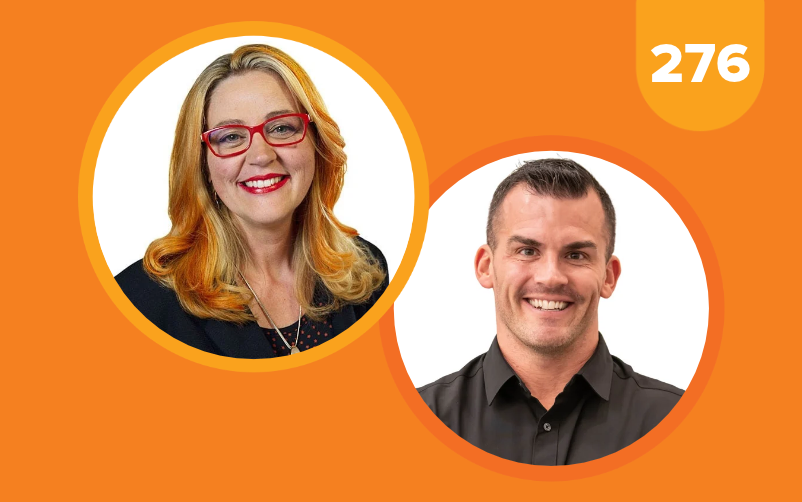
Search Everywhere Optimization: The Future of Search with Sean Garner
Subscribe at any of the services listed above. 👌
And if you like what you hear, please consider leaving us a 5 star review!
Sean Garner


About Sean Garner
Sean Garner is an entrepreneur, marketing strategist, and the founder of Sean Garner Consulting, a full-service agency and fractional CMO partner for local service-based businesses.
With over a decade of hands-on experience, Sean has helped health and wellness companies, medical clinics, law firms, coaches, consultants, and home service providers grow with clarity, confidence, and consistent lead generation. Drawing from his background as a gym owner, firefighter, and faith-driven family man, Sean understands the realities of running a business while juggling life’s priorities.
His superpower is simplifying marketing, turning confusing tactics into clear, actionable steps that drive real growth. Whether it’s through story brand messaging, website design, or sales funnel strategy, Sean empowers business owners to take control of their marketing and become the trusted go-to choice in their market.
Topics discussed in this episode with time stamps
00:00 – 00:27 “We are not relying on automation to grow our business. The point of the automation and leveraging AI in the business is to capture the people that fell through the cracks. Human touch is still always going to win. I’ll die on that hill for a long time. I think that the AI and the automation is great to make sure people don’t fall through the cracks. But if you’re relying on that and you’re frustrated that your business is stagnated, that’s because guess what? People love people. People love humans. So be human and connect to those people.” — Sean Garner
00:28 – 00:45 Welcome to Peppershock Media’s Marketing Expedition Podcast
00:46 – 01:44 About Sean
01:45 – 06:42 Marketing Essentials Moment: Universal Commerce Protocol on Google
06:43 – 09:04 Welcome to the show, Sean!
09:05 – 11:15 Effective Marketing Tactics
11:16 – 12:39 Automating Google Reviews
12:40 – 14:27 Search Everywhere Optimization
14:28 – 15:25 Client Onboarding Process
15:26 – 20:07 Understanding Client Goals and Competition
20:08 – 22:52 The Role of Video in Marketing
23:28 – 25:20 Utilizing Testimonials for Credibility
25:21 – 27:44 Leveraging YouTube for SEO
27:45 – 35:07 Tools for Marketing Success
35:08 – 36:07 Reach out to Sean
36:08 – 36:50 Words of Wisdom from Sean
36:51 – 37:06 Thank you so much, Sean! Share this podcast, give us a review, and enjoy your marketing journey!
37:07 – 37:52 Join the Marketing Expedition Community today!
Like what you hear, but need more information?
———————————————————————————————————————
Read the full transcript
Sean Garner: We are not relying on automation to grow our business. The point of automation and leveraging AI is to capture the people who fell through the cracks. Human touch is still always going to win. I’ll die on that hill for a long time.
AI and automation are great for making sure people don’t fall through the cracks. But if you’re relying on that and you’re frustrated your business is stagnating, it’s because people love people. People love humans. So be human and connect.
Intro
Welcome to the Marketing Expedition podcast, an auditory journey through the latest in marketing, branding, and advertising. Now, here’s your Marketing Expedition guide, Rhea Allen.
Rhea Allen: On this episode of the Marketing Expedition podcast, I get to speak with Sean Garner. He’s an entrepreneur, marketing strategist, and the founder of Sean Garner Consulting—a full-service agency and fractional CMO partner for local service-based businesses.
With over a decade of hands-on experience, Sean has helped health and wellness companies, medical clinics, law firms, coaches, consultants, and home service providers grow with clarity, confidence, and consistent lead generation.
Drawing from his background as a gym owner, firefighter, and faith-driven family man, Sean understands the realities of running a business while juggling life’s priorities. His superpower is simplifying marketing—turning confusing tactics into clear, actionable steps that drive real growth.
Whether it’s through StoryBrand messaging, website design, or sales funnel strategy, Sean empowers business owners to take control of their marketing and become the trusted go-to choice in their market.
We talk about all kinds of things today. We got to geek out about marketing, SEO, and more—so stay tuned.
But first, it’s time for your Marketing Essentials: the basics you need to keep building your brand and your bottom line.
Marketing Essentials: Universal Commerce Protocol (UCP) on Google
Rhea Allen: For this week’s topic, I want to dig in a little more on Universal Commerce Protocol on Google.
UCP—Universal Commerce Protocol—is expanding into new industries, starting with lodging and food. Right now, you can join the waitlist, but it’s positioned to become universal.
The big idea: UCP will standardize commerce so brands can enable AI-driven interactions that lead to instant sales. Think “agentic” actions in Google Search and Gemini—where people can buy directly from the results.
This is a chance to prepare now. As UCP rolls out, brands will be able to become the merchant of record—keeping customer data and relationships in one place through a universal merchant center.
If you already use Google Merchant Center, you’ll likely be building on what you have. Shopping feeds can capture high-intent customers while they’re discovering products and services through AI Mode and related experiences.
UCP is expected to unlock access to users across Google’s AI surfaces—AI Mode in Google Search, Gemini, and the Gemini web app.
Google is also promising flexibility in the integration, including:
- Building shopper confidence at scale with systems designed for trust
- A transparent accountability trail between merchants, credential providers, and payment services
- Secure transactions with consistent verification
It’s also expected to include native checkout—embedded directly in AI Mode results—so customers can complete purchases without leaving the experience.
For brands with more complex checkout flows, there may be iframe-based solutions embedded in results, making it easier for customers to buy even highly bespoke services.
Bottom line: start thinking now about how your website, your product/service data, and your commerce setup can support agentic commerce across Google’s AI surfaces.
There’s more to come as Google shares additional details, and as we learn how this will integrate with the tools and tech stacks our clients already use. But for now, consider joining the waitlist and getting ready.
And now, let’s get into our interview with Sean.
Interview
Rhea Allen: Welcome to the Marketing Expedition podcast. I’m your host, Rhea Allen. I’m the President and CEO of Peppershock Media and the founder of the Marketing Expedition community. Welcome to the show, Sean.
Sean Garner: Ms. Rhea, thank you so much. I’m excited to be here and hopefully share some value with the audience today.
Rhea Allen: Absolutely. Let’s start with you—what got you to where you are now, and what are you working on? Tell us a little more about you, Sean.
Sean Garner: We’ve had our agency, Sean Garner Consulting, for about eight years. We started more in the fitness and business-coaching realm, and the agency has evolved into a full-service digital marketing agency.
We do StoryBrand messaging, website design, sales funnels, search engine optimization—which we now call search everywhere optimization—Google Ads, and marketing consulting to help brands grow and dominate online.
My wife and I also own several businesses. That’s always my caveat: I’m not just the marketing guy giving advice I saw on YouTube or heard at a conference. We own several local service-based businesses.
We own a functional medicine practice and a medical spa. A lot of what we do, I get an unfair advantage because I can test it in our businesses before we roll it out to clients.
My wife and I have been married for 22 years. We have three amazing kids. We’re both serial entrepreneurs. I love helping small businesses—specifically helping them reach the right people they’re called to serve.
Rhea Allen: I love that. We have something in common—my husband and I also work together at our agency, and we’ve also been married for 22 years.
Sean Garner: Love it. Congratulations.
Rhea Allen: Thank you. It takes a special relationship to work together and run a business together.
Sean Garner: If you make it through that, you’re pretty strong.
Rhea Allen: Exactly.
Sean, you mentioned you get to “try before you buy.” What are a couple tactics you’ve implemented in your businesses—and then brought to clients—after you proved they worked?
Sean Garner: I’ll give you a few examples.
One is something anyone can do: a missed-call text back.
In local services, speed-to-lead is everything. If someone needs a plumber, roofer, or HVAC tech, they’ll search and start calling down the list. Whoever answers first usually gets the lead.
If you’re busy and you miss the call, you need something that at least engages the person—otherwise you’ll lose them. By the time you call back, they’ve already called two or three competitors.
We took a tactic common in home services and applied it to our med spa. As soon as someone calls and we don’t answer, an automated text fires:
“Hey, thanks for calling WellSpot IV. Sorry we missed your call. How can I help?”
Now, instead of waiting for a callback—or calling the competition—they’re texting us. When our team is free, they can jump into the conversation with context.
Another big one is automating Google reviews.
We have an amazing staff, but they’re focused on patient care—not thinking about review requests. You can put a QR code at the front desk, or hope the team asks every time, but it’s inconsistent.
So we automate it. When a ticket is closed or an invoice is completed—whatever your trigger is—we send a review request.
And here’s what we learned through testing: you have to ask three times.
We send the first request. If they haven’t left a review in three days, we send a second variation by text and email. Three days later, if they still haven’t, we send a third variation.
Only about 10% of reviews come from the first ask. About 90% come from the second or third.
The other big area is how SEO works for local service-based businesses—because it’s changed a lot in the AI age.
That’s why we call it search everywhere optimization. We’re doing things that used to be “enterprise-only,” like digital PR, and seeing how it impacts AI Overviews and LLM visibility.
A local plumber isn’t thinking, “I need digital PR.” But those signals influence not only rankings, but also how businesses show up in ChatGPT and other LLM results—because that’s where they’re pulling and citing information.
Rhea Allen: That’s so helpful—and it’s cross-platform. Like you said: show up in Gemini, ChatGPT, Perplexity… all the places.
Google also announced they’re integrating Gemini into shopping and more surfaces. There’s still a need for SEO, but it’s evolving.
Sean Garner: Exactly. I don’t want people to pigeonhole SEO as “Google only.” It’s search everywhere.
Even social platforms like LinkedIn and Instagram are being indexed. People are using chat tools to find service providers. A good SEO strategy isn’t about hacking an algorithm—it’s about being clear and proving it, so you show up everywhere.
Rhea Allen: When a new client comes to you and says, “I need more leads,” what’s your onboarding process? How do you figure out what they actually need?
Sean Garner: We use what we call the Marketing Domination Framework.
When we say “dominate,” we don’t mean crushing competitors. For us, entrepreneurship is a calling. Dominating means doing it with excellence—being the best version of you.
The framework revolves around a sales funnel. We help clients:
- Build a sales funnel
- Fill a sales funnel
- Optimize a sales funnel
A sales funnel isn’t a landing page style or a software tool. It’s a relationship journey.
Here are the key parts:
- Branding: Not just visuals—your message. I’m a certified StoryBrand guide, and that’s the framework we use.
- Website: Your website should be your best salesperson. If it’s not collecting leads and making money, it’s a pretty digital billboard.
- Lead capture: A lead magnet or lead generator—PDF, quiz, mini-course, video series, discount—something to capture people who aren’t ready to book yet.
- Automated follow-up: This is where automation matters. We’re not relying on automation to grow the business. We’re using it to capture people who fell through the cracks. Human touch still wins.
- CRM/database: A place to store leads, booked calls, and customer info—so it’s not trapped in someone’s inbox.
- Digital storefront: Social profiles, directory listings, Google Business Profile—everything built out and consistent.
Once that’s built, then we can market with SEO, Google Ads, and other channels.
When clients say, “I just need more leads,” there are three things we evaluate to set expectations:
- Where you are now: Most businesses don’t know their baseline. How many people visit your site? What do they do there? Is it a traffic problem or a conversion problem?
If you don’t know what’s working, you don’t want an agency to change everything and break what was working.
We also see a lot of gaps in basics—like not having Google Analytics or Search Console set up.
- Where you want to go: I might want to scale a business one way, but it’s not my business. We align on goals: growth, exit, replacement, better systems, more lead flow—whatever the owner wants.
- What the competition is doing: This is the hardest to measure quickly, but it’s critical—especially for SEO.
SEO is about being clear and proving it. If your competitors are publishing the same amount of content and building the same quality links every month, the gap won’t close.
I use a fitness analogy: if you’ve been on the couch for five years and you’re competing with someone who runs the Boston Marathon every year, it doesn’t matter what training plan you pick if you can’t close the gap.
The same thing shows up in ad spend. If you’ve never run Google Ads, it can be a harsh reality check when you see what competitors are willing to spend to acquire customers.
We’re good at what we do, but we’re not going to get results tomorrow. There’s no magic button.
Those metrics help us build the plan, set timelines, and manage expectations.
Rhea Allen: That’s such a valid point. People want instant gratification—like speed-to-lead. They want the phone ringing immediately.
But it takes time to learn what works, what doesn’t, what to stop, what to start, what to tweak.
Ad Read
Want to start a podcast but don’t know where to begin?
At Poderific, we don’t just produce podcasts—we help you create auditory experiences that captivate your audience.
Our state-of-the-art podcast recording studio, powered by Peppershock Media, is designed for creators like you. Record with high-quality equipment supported by our expert team, and distribute your podcast across major platforms like Apple and Spotify.
Whether you’re launching your first episode or you’re a seasoned podcaster, we’ve got you covered.
Visit Poderific.com today to learn how we can help you produce, record, and share your story with the world.
Your podcast deserves to be Poderific.
Continuing the Interview
Rhea Allen: Another component we do a lot of is video. Subtitles, video as part of the content strategy, driving traffic, keeping people on the site longer—video can be a big lever.
Do you do much with video?
Sean Garner: We sub it out, but I think it’s key.
I push clients to do one or both of these:
- Video content on the website
- Video content for social distribution
Video helps user experience and time on page. Google can tell if someone clicks your listing and bounces right back because the site wasn’t engaging or didn’t have clear calls to action.
Video—like a facility walkthrough, the lead practitioner explaining services, or the team talking about what they do—helps.
I also love when local service businesses do a video podcast. It’s one of the best returns on time. You can pull expertise out of the owner without them having to write everything.
Then your team—or your agency—can repurpose it into website content with a unique perspective. It’s not just what we found on Google or generated with AI. It’s your way of doing things.
Rhea Allen: Exactly. And you can repurpose into blog posts, audiograms, snippets.
Testimonials are another big one—having other people talk about the business. We’ve been doing short testimonial snippets and rewarding people who participate.
I hadn’t thought about it for a dentist or med spa, but that could be gold.
Sean Garner: Absolutely. SEO is about proving it. Google isn’t going to guess whether patients got results.
That’s why reviews matter. And video testimonials are huge—because very few competitors have fresh ones. If they do, they’re often from five or ten years ago.
Up-to-date video testimonials help SEO and conversions.
Rhea Allen: And because Google owns YouTube, YouTube videos can show up in Google results—with a thumbnail that gets more clicks.
I’m curious how video will be incorporated into ChatGPT and Gemini, especially with subtitles—because then the bots can read what’s being said.
Sean Garner: It’s already happening.
In AI Overviews, one of the most common sources is YouTube. Google can read transcripts for context—not just titles and descriptions.
That’s why video podcasts, sales videos, and testimonials are so powerful. These platforms can read them and pull them into citations.
There’s also a big opportunity in LLM referrals.
In Google, you search “roofer near me,” and you get a map pack—closest businesses with the most reviews—plus legacy SEO players.
In ChatGPT, there’s more context. It knows your preferences and your history. So the referral can be more curated.
The more you take what’s happening in the real world and put it online—blog posts, community events, sponsorships—the more data points the LLM has.
That can influence who gets recommended.
And when someone gets referred from ChatGPT, conversion rates can be higher because the recommendation feels more personalized.
Rhea Allen: I love that. We could talk about this all day.
Sean Garner: I do.
Rhea Allen: What tools would you recommend listeners check out—especially in the context of what we’ve been talking about?
Sean Garner: I’m tool-agnostic, because a tool is a tool. But for our systems, there are a few we use.
I like GoHighLevel for a lot of small businesses. If you haven’t heard of it, it’s an all-in-one marketing suite: social posting, email marketing, phone system, landing pages, websites, two-way texting, AI agents—almost everything.
That doesn’t mean you need every feature.
We work with medical practices, for example, and they may need a specific EMR. That’s fine. A tool is only as good as your ability to implement it.
For small businesses, GoHighLevel is great for:
- Phone systems
- Two-way texting
- Email campaigns
- Google review automation
- Reputation management
It integrates with a lot of tools—ServiceTitan, booking software, EMRs, accounting platforms—so you can automate triggers and keep one marketing database.
I also love Claude as an AI platform. It’s what we use internally most.
We built a “second brain” for our team—a shared database with almost infinite memory. It stores transcripts from client meetings, connects to SEO platforms, and has access to first-party data like Google Search Console and Google Analytics. It also connects to shared Google Drive files.
That way, when we write content, it’s not “write a generic blog post about plumbing tips.” It knows the client’s tone, their call recordings, internal details you can’t find online, and their actual data.
The big idea: these tools work best when they’re integrated. The more context you feed them, the better the results.
Rhea Allen: That’s fantastic. Sean, thank you for all the nuggets of wisdom.
How can people get a hold of you?
Sean Garner: Best way is my website: SeanGarner.co.
I also have the Marketing Domination Podcast if you want to hear more marketing conversations like this.
And for your audience specifically: go to SeanGarner.co/MarketingExpedition.
We’ll give you the template messages we use for Google reviews—the three emails and three text messages, three days apart. We’ll also show you how to set up the automations yourself.
Rhea Allen: Thank you—that’s awesome.
Any last words of wisdom before we wrap?
Sean Garner: Go take action.
If you’re an entrepreneur, it’s a calling. Don’t live out your calling in mediocrity.
Take action so you can connect with and serve the people you’re called to serve. There are people dealing with a problem that only you can solve.
Rhea Allen: I love that. Thank you again, Sean, for joining me today.
Sean Garner: Yes, ma’am. Thank you.
Rhea Allen: And for those of you listening, the best thing you can do for Sean and me is share this with others who need to hear it.
Until next time, everybody—enjoy your marketing journey.
Outro
Thanks for listening to the Marketing Expedition podcast. Want to continue the journey? Don’t miss out on new episodes—subscribe on iTunes, Spotify, Amazon Music, or wherever you get your podcasts.
Wouldn’t it be great if there was one place you can go to get all the latest information and tips about marketing and advertising? The Marketing Expedition community is that place.
People like you gather in our online community to build relationships with others and find the latest marketing trends, tactics, tools, and technology. We help you build your brand and your bottom line.
Start your adventure today. Visit TheMarketingExpedition.com to find out more.
Links to resources mentioned in this episode
Check out Rhea’s Marketing Expedition Webinars
Thanks for listening to this episode of the Marketing Expeditions Podcast. If you like what you heard today, please subscribe and leave us a review on iTunes, Spotify, or Amazon Music.
The Marketing Expedition Podcast is powered by Peppershock Media, an award-winning full-service advertising, marketing, and video production company.